What is a filibuster?



What exactly is a filibuster?
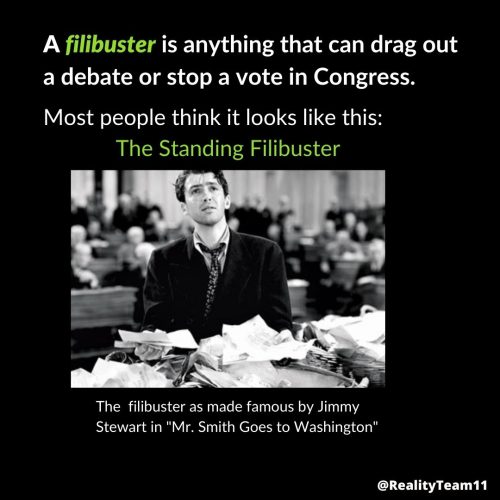
The filibuster is used to stall action in Congress. Also known as “talking out a bill,” the filibuster can delay debate and prevent voting on a piece of legislation.
You might be imagining an exhausted sweaty senator talking for hours on end and that used to be true. The modern filibuster or “silent filibuster” is a whole different animal.
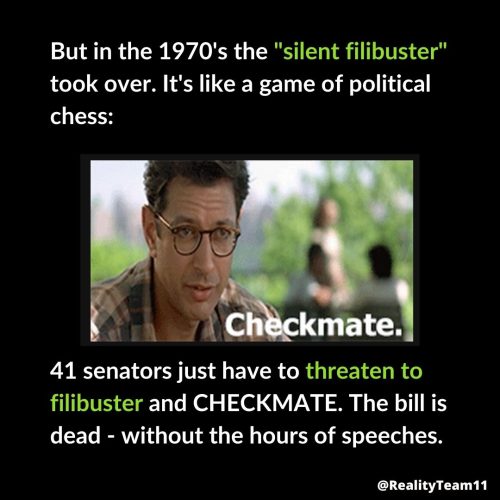
Instead of someone talking a bill to death, 41 or more senators merely have to threaten to do it. In that case the majority leader won’t even call for a vote. It’s like when a chess player tells their opponent they have “checkmate” in a few moves. After that they don’t even bother playing out the game.
Is it part of the Constitution?
No, it’s a Senate rule that came about because of a loophole.
To completely understand it you have to know how Congress passes legislation.
In the simplest of terms:
- A new bill is introduced.
- A committee discusses the bill, holds hearings on it, and decides when it’s ready to be introduced to the floor.
- The bill goes to the senate floor for debate.
- A simple majority vote of 51 senators makes the bill a law.
Here is where the filibuster comes in: before the Senate can vote, they have to close the debate. But if a senator just keeps talking or threatens to filibuster, then the debate never ends, and a vote never happens.
The history of the filibuster
The filibuster is NOT a part of the constitution.
It’s actually a loophole created accidentally by Vice President Aaron Burr in 1806, when he changed the Senate rules about debates. Before that, closing a debate required a simple majority vote, but thinking a vote to end debate was redundant the rule was removed. This left the Senate with no official way to end the debate.
In 1917, the Senate again changed the rules, requiring a supermajority or 67 senators to vote to end debates. In 1975 they reduced this number to 60.
They call the vote to end debates, cloture.
The filibuster used to be a last resort on only the most controversial of issues. However during recent years, the use of it has increased dramatically. There have been over 2,400 filibusters in U.S. history, with about half of them happening in the last 12 years.
So what are some implications of the filibuster?
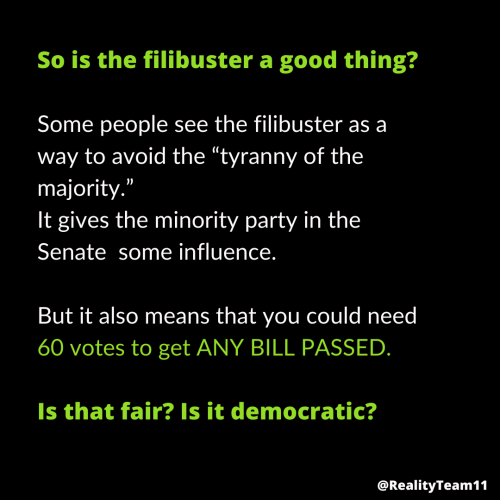
Some people tout the filibuster as a way to avoid the “tyranny of the majority.” It’s a way for the minority party in the Senate to ensure that they don’t get railroaded. But it also effectively means that in order to actually get a bill passed you need 60 votes to ensure that a debate ends, effectively meaning you could need 60 votes to get ANY BILL PASSED.
Can it be changed?
Yes! It’s a Senate rule and the Senate can vote to change it without any amendments to the Constitution.
Youtube: Mr. Smith Goes to Washington Speech
United States Senate: Cloture Motions
Brennan Center for Justice: The Case Against the Filibuster
AllGov: Virtual Filibusters Bring Congress to Standstill
The Christian Science Monitor: What’s a filibuster look like? Not Jimmy Stewart
Slate: Post–“Nuclear Option,” Remember the Most Famous Filibusters on Film and TV
Youtube: The Queens Gambit, Season 1, Episode 2 – Beth Harmon VS Harry Beltik
Related Cards