
Does printing money cause inflation?
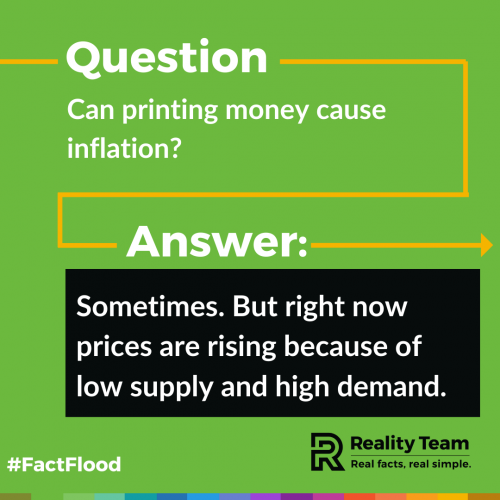
Videos on Youtube and other sources allege that 40% of all US money was created in the past year. What they’re really suggesting is that the US government is going to kick off high inflation and increase the cost of everything. And they’re doing this at a time when the cost of everything is coincidentally going up.
This is a very clear example of a disinfo trick we call “Fake Cause and Effect.” Here’s a quick explainer on what inflation is, how it works, and what is driving inflation right now.
Table of Contents
What is inflation?
Inflation is rising prices.
What are the types of inflation?
You’ll hear a few kinds of inflation thrown around. Here is a simple list of the most common ones:
- Creeping Inflation: Prices go up 3% or more.
- Walking Inflation: Prices go up between 3-10%.
- Galloping Inflation: Prices go up by more than 10%.
- Hyperinflation: Prices go up by more than 50% in a month.
What typically causes inflation?
Economists use three broad terms to describe ordinary inflation.
- Demand-Pull Effect: Prices go up because of an increase in demand and a lack of supply to meet that demand.
- Cost-Push Effect: Prices go up because it costs more to make stuff and deliver services.
- Built-In Effect: Prices go up because people expect other prices will go up and they adjust theirs as well.
Bottom line
Prices typically go up because of shortages (demand exceeds supply) or because it costs more to make stuff and provide services.
Why are prices goin up now (or why do people expect prices will go up)?
The pandemic disrupted supply chains. This created some shortages initially (remember when no one could find toilet paper?) and others appeared in the long term. It also created new kinds of demand.
What kind of shortages and increases in demand are currently happening?
Buckle up because we’re about to get thorough in a rapid fire succession of bullet points.
- Lumber: The pandemic shut down lumber production and the housing market got hot.
- Housing: People are relocating and renovating. In addition, venture capital, hedge funds, and corporations are buying up houses nationwide to convert them into rentals, further driving up the price and demand through bidding wars and outright cash offers. The lumber shortage further exacerbates this.
- Trucking: There is a shortage of truck drivers since a pandemic-induced demand for trucking increased following a drop-off in truckers and trucking companies in 2019. That in and of itself affects most of the economy, since everything on the mainland is transported either by rail or by road. And on that note…
- Shipping containers: Shipping containers are in demand, both because demand for goods transported by ship increased and because of shipping and offloading delays. Several mega cargo ships have been stuck off port waiting to dock in California, contributing to delays. Larger ships with more containers to unload means an increased need for more labor and longer wait times, and delayed ships means fewer shipping containers available. In addition, larger and larger cargo ships have created bottlenecks as the number of ports able to accommodate them decreases.
- Paper products and household goods: Remember when the Suez Canal got blocked and all the ships stopped moving or diverted around Africa? 90% of everything is transported by ship, so it was kind of a big deal, and it disrupted routine shipments like wood pulp. No wood pulp, no toilet paper and paper towels. It’s that simple.
- Gasoline: A ransomware attack on a major pipeline just shutdown gasoline availability on parts of the east coast. People are also panic buying gasoline and storing it in containers, exacerbating shortages. Also, there is a shortage of truckers (see above) to transport gasoline to gas stations, so expect this to continue into the summer.
- Electronics and cars (semiconductor chips): There is a shortage of semiconductor chips, which are used in everything electronic, including new cars. There are efforts to increase semiconductor chip production, but it’s going to take years to get there because they need to build the facilities and find new sources of rare earth minerals. In the meantime, our appetites for everything digital continue to increase, and our COVID-induced confinement spiked demand for things like computers and TVs.
- Plastics and packaging: Plastics come from oil. Texas produces a lot of oil. Texas also produces a lot of plastics. The freak winter storms that hit Texas disrupted plastic production, in turn driving up packaging costs.
- Chicken: Those same winter storms that hit Texas also disrupted chicken production. Less chicken being processed means fewer chicken wings and chicken sandwiches.
- Stimulus checks: Sending stimulus payments to the general public increases demand as people purchase things they need, delayed buying, or want now to help cope with all the stress of the past year.
- Pet food: People adopted new pets during the pandemic. More pets means a higher demand for pet food.
- And so on. We can keep going on the shortages for a long, long time. Cardboard, metals, furniture, aluminum cans, used cars, rental cars, workers themselves…
Are you noticing a pattern?
It traces back to two root causes: COVID-19 and unforeseen events (weather, ransomware, shortages in stuff used to transport stuff) disrupting supply chains.
Bottom line
Did increasing the money supply contribute to some inflation? Yeah, probably. People have more money to spend and they want to spend it. But the increases in prices we’re seeing and will see have more to do with shortages than with printing money.
References
- Business Insider: Can’t find chicken wings, diapers, or a new car? Here’s a list of all the shortages hitting the reopening economy.
- Business Insider: The US is facing a supply-chain crisis as 21 cargo ships float off the coast of LA waiting to dock
- USA Today: Before the pandemic ketchup squeeze: A year of COVID-19 product shortages and the items we struggled to find
- The Washington Post: Economic tremors hit White House at crucial moment for Biden policy agenda
- Also this chart from the above Washington Post article: Twitter
- The Washington Post: EXPLAINER: Why are fears of high inflation getting worse?
- The Washington Post: Inflation is up. The stock market is down. Here’s why you shouldn’t panic.
- Wall Street Journal: Commodities Boost Economic Recoveries, Mirroring Aftermath of Financial Crisis
- Wall Street Journal: The U.S. Economy Is Back. Businesses Aren’t Ready.
- Wall Street Journal: U.S. Shoppers Continued Stimulus-Fueled Spending in April
- Bloomberg: Gasoline Pinch to Grind on for Weeks With Truck Shortage
- WUSA9: VERIFY: We’re running out of wood. Here’s why there is a lumber shortage
See an error in our work? Please let us know and include the source of your info. We’ll update or correct as appropriate.